Military Spouse
  • Employment
    • Military Friendly Employers
    • Virtual Job Fair
  • Education
  • Entrepreneurship
    • Open A Franchise
  • Life
    • Deployment
    • Homecoming
    • Moving
  • Relationships
  • At Home
  • Magazine
    • Current Issue
    • All Magazines
No Result
View All Result
  • Employment
    • Military Friendly Employers
    • Virtual Job Fair
  • Education
  • Entrepreneurship
    • Open A Franchise
  • Life
    • Deployment
    • Homecoming
    • Moving
  • Relationships
  • At Home
  • Magazine
    • Current Issue
    • All Magazines
No Result
View All Result
Military Spouse
No Result
View All Result

The Three Most Important Words in the War

Military Spouse Team by Military Spouse Team
in Deployment, MSM Update, News
0
0
VIEWS
Share on FacebookShare on Twitter

There’s a phrase you might have heard used in discussions about Afghanistan: bilateral security agreement.

They’re no less than the three most important words in terms of what happens next in the war. The bilateral security agreement is the contract between the U.S. and Afghanistan that dictates what the relationship between the two countries will be after the drawdown of forces.

The Background
On May 2, 2012 President Barack Obama and Afghan President Hamid Karzai signed a document called “Enduring Strategic Partnership Agreement between the Islamic Republic of Afghanistan and the United States of America.” That document details the future relationship between the two countries and in it both countries agreed to negotiate a bilateral security agreement within one year.

Karzai has repeatedly said that he won’t sign the bilateral security agreement because he believes having Americans in Afghanistan after this year is not in the best interest of his country. His country, however, disagrees.

The agreement has mainstream approval in Afghanistan’s political community, having been approved by both the loya jirga in November 2013 and more recently by the two candidates for president of Afghanistan, Abdullah Abdullah and Ashraf Ghani Ahmadzai.

Why It’s Important
Without an agreement allowing our troops to stay and continue the transition, President Obama has said that all U.S. troops will be out of Afghanistan by December 31, 2014. American officials say that without an agreement in place, it would be impossible for our troops to continue to operate in the country as the agreement dictates things such as U.S. access to military bases in Afghanistan and which country’s laws will govern the actions of U.S. troops there. Karzai says that he will leave the signing of the agreement up to his successor, who should be in office by August.

But Don’t We Want All of Our Troops Out of There?
Yes, of course we do. But how and when we leave Afghanistan will be important in determining what happens there after the war. Afghanistan is, by all accounts, a country in chaos and the Taliban is still strong. Many fear that a hasty American withdrawal will allow the Taliban to move into a power vacuum. That’s what happened after the Soviets left Afghanistan in 1989 and why the Taliban was in power and able to allow bin Ladin’s Al Qaeda to operate and plan the September 11, 2001 attacks against the U.S. from Afghanistan.

Many experts are also looking to the current state of Iraq as an example of what the United States should seek to avoid in Afghanistan.

In a commentary published Sunday, May 4 on CNN.com, Rep. John Boehner, Speaker of the House, compared Afghanistan to Iraq, saying:

“It is increasingly apparent that the United States left Iraq too soon, and it is with heavy hearts that we see the black flags flying in areas of Iraq where the United States expended our most precious treasure, the blood of our fellow citizens. We cannot let that happen in Afghanistan. A bilateral security agreement is critical if we’re going to successfully complete the work that has been accomplished to date and to help ensure that the gains we have made are not jeopardized like they have been in Iraq.”

So What Happens Now?
Now we wait and see. President Karzai, who has already served two terms, is not eligible for a third term. Last month Afghanistan held a presidential primary election and both primary winners have said that, if elected, they will sign the bilateral security agreement, meaning that U.S. troops will be allowed to stay longer. The U.S. has estimated it needs 102 days to conduct an orderly withdrawal – meaning a decision on American troop numbers in Afghanistan must be made by September.

According to General Joseph Dunford, the top U.S. Commander in Afghanistan, if Karzai’s successor signs the agreement, the Pentagon will be able to plan for a post-2014 scenario. Currently, without the agreement signed, the Pentagon is planning for two contingencies: a complete withdrawal after December 31 or a limited withdrawal with a conversion of a remaining force of 3,000 to 10,000 troops still in the country.

As Ryan Crocker, former U.S. ambassador to Iraq and Afghanistan, “I’ve said it before – the very best exit strategy is not to have an exit strategy,” Crocker told Time Magazine, “signaling to friends and foes alike that we’re in this for the long run.”

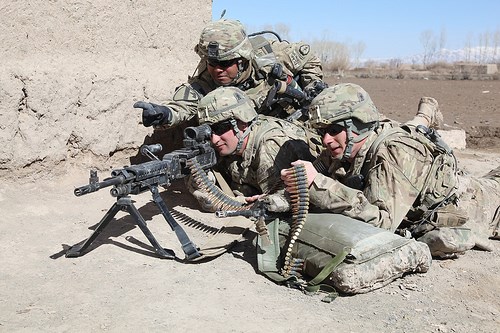
photo credit: <a href=”https://www.flickr.com/photos/dvids/6841684056/”>DVIDSHUB</a> via <a href=”https://photopin.com”>photopin</a> <a href=”https://creativecommons.org/licenses/by/2.0/”>cc</a>


Tags: Afghanistanbilateral security agreementdrawdownISAFKarzaiWarwithdrawal
Previous Post

Crush the Mental Health Stigma – Take the Pledge!

Next Post

12 Tips for PCSing with Kids

Next Post

12 Tips for PCSing with Kids

Please login to join discussion

Latest

MSOY

2026 AFI Space Force Spouse of the Year

Life

Decision Fatigue: When Your Entire Life Resets Every Three Years

Life

Sometimes, It’s Not Actually About You

Life

Just Checking In! 3 Reasons to Reach Out Even When It’s Awkward 

Life

No Blueprint, No Script: Perfecting the Pivot in Military Life

Life

When Everything Familiar Changes: Navigating Culture Shock After a PCS Abroad

In Case You Missed It

When Military Life Becomes “Unique”

You Fought for Others — Now Fight for Yourself

You’re Not Burned Out. You’re Depleted.

When “Resilience” Becomes Chronic Deprioritization

The Quiet Grief of Military Goodbyes

When One Friend Becomes Everything

Terms of Use
Our Team
Advertise
Newsletter
Submit an Article
Contact Us
Privacy Policy
Compliance

Fall 2025

MSM_Fall25_Cover

Copyright © 2026 Military Spouse

Employment

Family

Lifestyle

Sitemap

No Result
View All Result
  • #5590 (no title)
  • 2016 Kensington Book Club
    • Author Guest Posts
    • Book Club Picks
    • Deals of the Month
    • Exclusive Excerpts
    • Giveaways
    • Recipes
  • 2017 Military Spouse Friendly Employers®
  • Account
  • Advertise
  • Affiliate Disclosure
  • Air Force
  • Army
  • Base SOY Survey
  • Base to Beaches
  • Brands
  • Career
  • Career Resources
  • Coast Guard
  • Compliance
  • Contact Us
  • Contests
    • Contest Rules
  • Deployment
  • Editorial Calendar – Our Themes
  • Education Resources
  • Giveaway Sign-up
  • Hangouts
  • Health
  • Home
  • Home 2
  • Home 3
  • Home 4
  • Home 5
  • Homeschooling
  • I Pledge to Embrace Video Page
  • Login
  • Logout
  • Magazine
    • Current Issue
    • Fall Issue
    • Fall Issue
    • January / February
    • July / August
    • March / April
    • May / June
    • November / December
    • September / October
    • Special Issue
    • Special Issue 2024
    • Spring
    • Spring Issue
    • Spring Issue
    • Winter
    • Winter Issue
    • Winter Issue
  • Malmstrom AFB SOY 2016 | Alexandra Fuller
  • Marine Corps
  • Members
  • Military Kids
  • Military Spouse [Live]
  • Military Spouse 2019 Media Partnership Guide
  • Military Spouse Education eNewsletter
  • Military Spouse Friendly Employers®
  • Military Spouse Media Partnership Guide
  • Military Spouse Partners
  • Military Spouse Quality of Life Survey
  • Military Spouse Student Leadership Award and Military Spouse Champions in Higher Education Award
  • Military Spouse Sweepstakes Official Rules (“Official Rules”)
  • Military Spouse Team
  • MILITARY SPOUSE: EDUCATION GUIDE
  • MILITARY SPOUSE: EMPLOYMENT GUIDE
  • MILITARY SPOUSE: PCS GUIDE
  • Military Spouse: Submit a calendar event
  • Money & More
  • MSOY Homepage
  • MSOY12
  • MSOY16 Live ☆
  • National Guard
  • Navy
  • Navy Mutual
  • New Spouse Email Series
  • Our Team
  • Password Reset
  • PCS
  • Privacy Policies
  • QAs
    • Submit a Question
  • Register
  • Share
    • Glossary
      • A
      • B
      • C
      • D
      • E
      • F
      • G
      • H
      • I
      • J
      • K
      • L
      • M
      • N
      • O
      • P
      • Q
      • R
      • S
      • Submit a Glossary Term
      • T
      • U
      • V
      • W
      • X
      • Y
      • Z
  • Share Your Military Lifestyle!
  • Share Your Photos
  • Simplify Your Crazy, Wonderful Military Life
  • Site Map
  • Small Businesses
  • Spouse 101 Download
  • SPOUSE 101 GUIDE
  • Starbucks
  • Submit an Article
  • Terms of Use
  • testing of the Gutenberg
  • Thank You
  • The Military Spouse Resource Collection
  • User

© 2026 JNews - Premium WordPress news & magazine theme by Jegtheme.