
There is a particular kind of exhaustion that military spouses know intimately. It’s the kind where your nervous system becomes so accustomed to surviving catastrophe that functioning in chaos starts to feel normal- until one day, it doesn’t.
For our family, the unraveling didn’t happen all at once. It happened slowly, quietly, over several years of deployments, reintegration struggles, medical trauma, and emotional suppression dressed up as “resilience.”
My husband deployed to the Middle East in 2019. Then, in 2021, he left again for a short tour to Korea. Two back-to-back years of separation changed our family in ways I don’t think any of us fully understood at the time. When he came home, he came home profoundly injured—physically, emotionally, psychologically.
And honestly? We were completely unprepared for what reintegration would actually require.
People love the reunion photos. The airport kisses. The signs made by children. The tears. The embrace.
What nobody talks about enough is what happens six months later when the adrenaline wears off and everyone realizes the family system itself has fundamentally changed.
By 2022, life felt impossibly heavy. There was a looming med board scare. Physical therapy five days a week. Constant medical appointments. PTSD symptoms. Anxiety humming beneath every conversation. Meanwhile, the world around us seemed to continue spinning normally while we quietly tried to hold our family together with duct tape and caffeine.
We were surviving.
Barely.
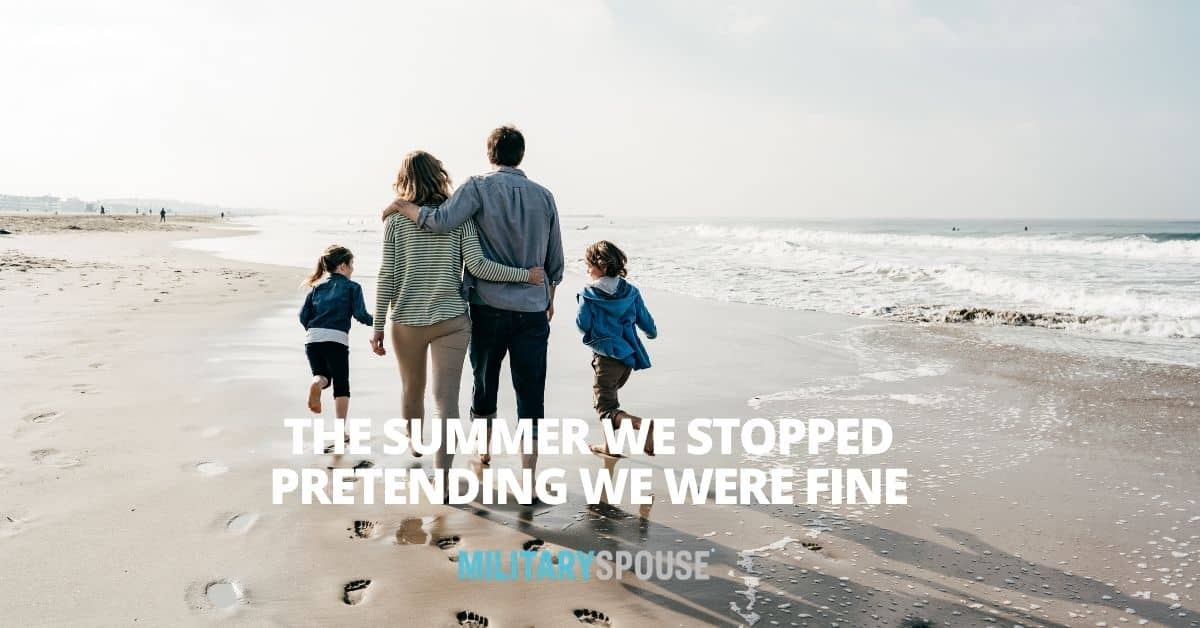
Then came the summer of 2023—the summer we finally stopped pretending we were fine.
It happened over coffee.
No dramatic music. No cinematic collapse. Just two exhausted people sitting in the kitchen carrying years of unspoken fear when my husband quietly admitted he was struggling with suicidal ideations.
Suddenly everything else stopped mattering. I remember the exact feeling that settled over me at that moment. It wasn’t panic or shock. The feeling that swept over me was definitely “Deployment mode.”
I immediately went tactical. “Circle the wagons.” I thought. “Protect the family and stabilize the situation. Pause everything unnecessary.”
I put the ministry I had spent years building on hold. Again. I shifted into survival mode so fast it startled even me. The checklists returned. Appointments. Schedules. Planning. Contingencies. Emotional management. Hypervigilance. All the familiar rhythms military spouses develop when crisis enters the home.
Meanwhile, my husband entered a Partial Hospitalization Program for PTSD treatment while our children transitioned back into public school. Life became a blur of trying to survive treatment schedules while simultaneously pretending we were functioning normally enough to keep pace with the rest of the world.
And for a while, I thought we were making progress.
But trauma has a way of collecting interest when left unpaid.
By the summer of 2024—one year removed from treatment and staring down military retirement—the cracks returned with a vengeance.
Only this time, the person breaking apart was me.
Preparing for retirement while emotionally recovering from years of survival mode felt catastrophic. Schedules shifted. Financial uncertainty loomed. Identity crises emerged. Relational fractures widened under pressure. Every conversation felt emotionally loaded. Every decision carried weight.
And somewhere in the middle of all of it, I broke.
I dropped out of a doctoral program I had worked incredibly hard to pursue. I put pieces of my life on hold yet again. But this time, instead of quiet acceptance, I felt rage, deep and unending grief, and bone-level exhaustion.
I did not want to stop dreaming again.
I did not want to put myself on the back burner again.
I did not want to spend another season surviving while secretly hoping someday it would finally be “my turn.”
That realization forced me to confront something difficult: military spouses often become so skilled at enduring hardship that we accidentally stop living entirely.
We become managers of chaos instead of participants in our own lives.
We postpone joy.
We delay rest.
We start to minimize our desires and completely ignore our grief.
We tell ourselves we’ll finally breathe after the deployment, after treatment, after the PCS, after retirement, after the next crisis.
But the hard truth is this: life may never stop being hard.
Military life certainly doesn’t pause long enough for perfect healing or tidy recovery arcs. There will always be another challenge, another transition, another uncertainty looming somewhere on the horizon.
So eventually, we had to ask ourselves a hard question:
What if we stopped waiting for life to become easy before allowing ourselves to enjoy it?
That question changed everything.
Not overnight. Not magically. Not perfectly.
Some days we are still a mess.
Some days PTSD still casts a shadow over our home. Some days retirement anxiety still creeps in. Some days grief still sits heavy in my chest. Healing is not linear, and pursuing it is not beautiful all the time.
But slowly, intentionally, we began trying to romanticize the regular.
Not in a fake “positive vibes only” sort of way. I mean intentionally noticing the life sitting quietly in front of us.
We have late night talks on the porch or share coffee together before the kids wake up.
We like watching movies piled on the couch or making dinner together. We tried laughing again.
I buy flowers simply because they make the kitchen feel alive and I walk at the beach at sunset instead of doom-scrolling through another exhausting news cycle.
Tiny moments of joy became acts of rebellion against survival mode.
Maybe healing is not always found in massive breakthroughs.
Maybe sometimes healing looks like teaching yourself how to live again after years of simply enduring.
The military taught our family how to survive crisis. But now, we are trying to learn something entirely different:
I am learning to build a life that actually feels like ours- a life with joy, connection, room to breathe- a life where hardship is acknowledged honestly but no longer worshipped as proof of strength.
And maybe that’s the real After Action Report here.
We shouldn’t push through at all costs.
Eventually, after the dust settles and the adrenaline fades, you have to decide whether you’re merely surviving your life—or finally willing to live it.